Somebody gave notice. Again.
Give me five minutes before you post the ad. I've run 817 of these searches for eye care practices, and I can show you where the time goes and how to skip most of it.
Book a 20-minute call with Dr. MikeKnow you want in?Start a search.See the demo first (2 minutes)
Dr. Mike's note
Hi there! I'm Dr. Mike, the Optometrist behind Made The Team. For a long time I had a rural practice in northeastern Pennsylvania, Lakeside Vision. If you've ever tried to hire in a small town, you know that's its own kind of hard.
My practice was hemorrhaging people. We tried to buy our way out of it. Didn't work. So we built our own way of doing it, and in December 2018 the first practice outside ours paid us to run it for them. Since then my team and I have run 817 searches for 219 practices in 45 states, and 116,310 people applied.
I know that number sounds made up. It isn't. We texted every one of them back, and we kept every record. Everything on this page comes out of that pile, not out of my head.
Dr. Mike
See what lands on your phone
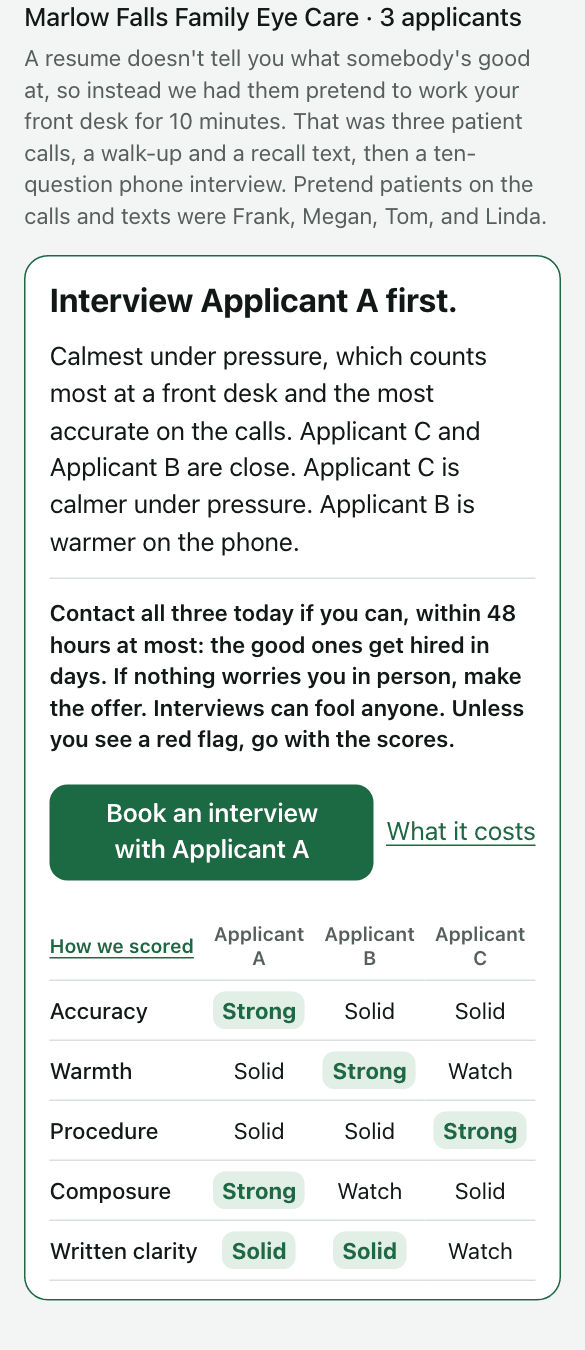
This is the page you get when the short list is ready: two or three names, what each one did on the Work Sample, our interview with them summed up, and one tap to book the interview. Nobody at your office touched a resume.
How it works
Your part, in total: one 20-minute call, the interviews, and the pick.
- TodayBook the call.We talk for 20 minutes about the job: the hours, the wage, your software, the plans you take, who the person reports to, and when you can interview. That builds your role card. If it's a fit, I text you the payment link on the call.
- Within two business daysRead one email.The market report. If your town or your wage can't fill the position, you hear it now, and you get everything back.
- The adNothing.Your ad goes live on about 20 job boards, with a career page that's yours to keep.
- Every applicantNothing. You see patients.A text within seconds from a local number that belongs to your search. Four quick questions. Then the Work Sample: 12 minutes on the phone doing your job. Then a recorded phone interview, the same questions for everyone. Scored blind: no name, no photo, no age. About 9 of every 10 don't get through.
- The short listNothing.Two or three names land by text, ranked, with what each person did and our interview summed up. We book the interviews at the times you gave us on the call.
- The interviewsInterview. Pick.30 minutes each, at your practice or by phone. You're the one who works with this person every day.
- The first 90 daysAnswer three texts.We check in at 30, 60 and 90 days. If the hire leaves or is let go, for any reason, we fill the position again at no charge.
Everybody does screenings. Nobody does work samples.
A screening asks people about the job. A work sample has them do it. Ours is 12 minutes on the phone: a patient calls to book an exam, another asks why there's a bill when they have a vision plan, one gets upset, and a second call lands in the middle of it. It's built from your role card, so it's your schedule and your plans.
Why it works:
- It's the actual job, under the actual interruptions, before anyone has seen a name.
- Everyone gets the same calls and the same written guide, so the scores compare.
- A resume can't tell you this. We scored resumes blind and checked them against the real hires: a little better than a coin flip. At predicting who'd pass the Work Sample, worse than the coin.
- It happens right after the four questions, on the applicant's own phone, so nobody waits for your calendar.
Why you can't run one yourself:
- About 80 people apply. Twelve minutes each is 16 hours of phone calls, and they have to happen the day people apply, not when your front desk has a gap.
- The patients on the line are played the same way for every applicant, every time. A person can't do that, and a different test for each applicant isn't a test.
- It's scored blind, before anyone sees a name. In your office, somebody always knows the name.
- It's built from your role card and scored against a written guide. Writing the guide took us 817 searches.
Your way, our way
What 116,310 applications taught us
- About 80 people apply to a typical front desk, technician or optician search. The supply was never the problem. What happens to those 80 after they apply is the problem.
- About 9 of every 10 wash out before a real screen. Most either can't do the job or won't finish the steps, and finding that out one person at a time is where your evenings went.
- If your ad requires experience, expect about 40 percent fewer applicants. Practices kept the "2 years optical experience required" line, then told us there were no good people in their town.
- Nothing we knew before a hire predicted who stayed. We took 560 hires, 85 of them gone inside 90 days, and checked nine things we knew beforehand: reply speed, reminders, time on the screen, test score, asking wage, commute, the blind resume score, and more. None of it called who'd leave. The screen tells you who can do the job. Whether they stay gets decided in your first 90 days, which is exactly what the guarantee covers.
These are counts from our own searches. They tell you what happened, not what will happen for you.
In writing
If the person you hire leaves or is let go inside 90 days of their first day, for any reason, we fill the position again at no charge, provided you gave us your interview times, or reached your finalists yourself, within 48 hours. It's a replacement, not a refund.
If the market report says your town or wage can't fill the position, we say so within two business days and you get everything back.
What it costs
$2,797 a hire, plus a $147 set-up.
- Paid once, before we introduce anybody. No percentage of salary. No monthly fee.
- First five practices: $500 off.
- Members: $2,297 a hire plus $97 a month. Ask on the call.
- A second position from the same search: $2,297.
What you get:
- Your ad and career page, yours to keep.
- Every applicant texted within seconds. Four questions, the Work Sample and the recorded interview, scored blind.
- A ranked short list of two or three, with the evidence, by text.
- The interviews booked for you, or the names and numbers to reach yourself.
- Check-ins at 30, 60 and 90 days.
- The 90-day replacement guarantee, in writing.
Know you want in?Start a search.
The number's here because I hate sitting through a call just to find out what something costs.
Who this is for
- Eye care practices. I'm an eye doctor and it's the only world I know well enough to do this in.
- Front desk, technicians and opticians. Office managers and billers: ask on the call. Not doctors.
- Spanish-speaking positions: ask on the call.
Questions doctors ask me
"Isn't this a job board?"
A job board sends you the pile. We're what happens to the pile: the text within seconds, the Work Sample, the blind scoring, the ranked list, the booked interviews.
"We can do this in-house."
The ad and the interviews, yes. The Work Sample, no. About 80 people apply, 12 minutes each, the same calls for everyone, scored blind before anyone sees a name, the day they apply. That's 16 hours of phone calls your front desk can't make, and it only works if nobody in your office knows who's on the line.
"I want somebody with experience."
I get it. But nothing we knew about a person before the hire predicted who stayed, and ads that required experience drew about 40 percent fewer people. In my own practice, about half the people we hired ended up in a different position than the one they applied for.
"There are no good people in my town."
About 80 people per typical search tells me they're out there, and I hired in a small town myself. If your town really can't fill the position at your wage, the market report says so within two business days, and you get everything back.
"Do I still do the interviews?"
Yes. Two or three of them, 30 minutes each. You're the one who has to work with this person every day.
"Who talks to the applicants?"
Our assistant, Scout, by text, and every text says it's automated. A person steps in whenever an applicant asks for one.
"What's your success rate?"
About 1 hire in 6 came back to us inside 90 days. That's what the guarantee is for. Past 90 days we didn't measure, and this time we will. I won't tell you we're going to be successful every time.
"Why is an eye doctor doing this?"
Because I needed it first. There was a stretch of a year and a half where I never once opened or locked my own front door. My team did. I'd like you to have that too.
Twenty minutes with Dr. Mike
Bring the position, the wage, and how long it's been open. I'll tell you what I'd do, whether or not you hire us. If it's a fit, we fill in your role card right there on the call, I text you the link, and your ad goes up as soon as you've paid.
Book the callBooking opens this week.
Know you want in? Start a search, and the 20-minute call is the first thing we book.